By Mr Hull's Movie Guides
Watch the Trailer

What's Inside the Guide
This is a 12-page classroom-ready resource.
Two full sets of differentiated comprehension questions in chronological order. Answer keys are included.
- 35 question set requiring full sentence answers.
- 35 multiple choice question set with 3 possible answers. The multiple choice set also works well with ESL and ELL students.
- A nine scene storyboard of what they consider the most important parts of the movie, with a brief description for each scene.
- A synopsis of the movie, written using the storyboard as a guide.
This part covers two activities. An answer key is included for the word search.
- A character profile, where students choose one of the listed characters, or another character of their choice, and cover a description, background, likes and dislikes, one change they would make to the character, and a favorite scene the character appeared in.
- A word search puzzle with 15 words to find, 5 of which require clues to be answered first.
“My students were so engaged with this. This saved me so much time. Thank you!”
— Joan E.
Why Watch This Movie With Your Students
Here's what your students naturally take away from the movie, whether through themes, values, ideas, or perspectives.
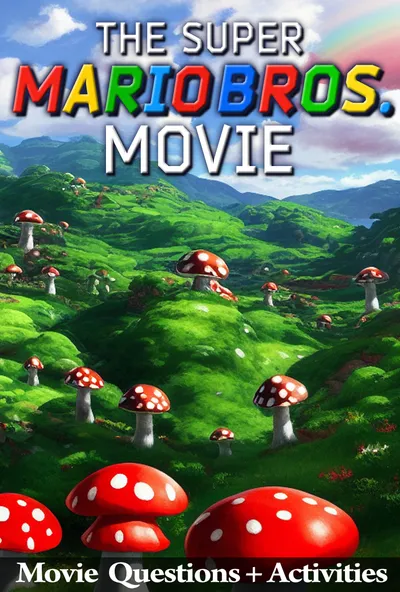
🍄 Centers on perseverance in the face of doubt and teasing. Mario is doubted by his family and a former employer, and hears plenty of insults along the way, but he keeps trying rather than letting it stop him. The movie ties his eventual success directly to that persistence.
👑 Gives students a proactive, capable female lead. Princess Peach leads her kingdom's defense herself, training Mario and organizing allies rather than waiting to be rescued. She is shown as brave and relentless, putting her people's needs ahead of her own throughout.
🤝 Builds its plot around teamwork between unlikely allies. Mario, Peach, and Donkey Kong all have different goals and personalities but have to work together to stand a chance against Bowser. The movie treats their cooperation as essential to the outcome rather than optional.
👬 Follows two brothers separated and determined to reunite. Mario and Luigi are split apart early on and spend most of the movie trying to find their way back to each other. Their reunion and combined effort is what ultimately turns the final battle.
🔥 Introduces a clear antagonist with an understandable goal. Bowser wants to force a marriage on Peach and conquer her kingdom, giving the story a straightforward villain whose motivations are easy for students to follow. His defeat comes through the heroes' persistence and cooperation rather than luck.
🎮 Adapts a widely recognized game franchise into a new story. Students familiar with the games will recognize characters, settings, and references pulled from across the franchise's history. It offers an accessible way into discussing how a beloved game gets reimagined as a movie.
Age Suitability and Content
This movie is rated PG.
⚠️ Things to be aware of:
- Cartoon action violence throughout, including a couple of scenes that younger or more sensitive students may find intense.
- Some mild name calling and bullying between characters.
- There is no strong language or sexual content in the movie.
📋 A free editable parent permission slip is available for this movie. It explains the educational benefits of watching movies in class and includes a space for parental consent. → Download Free Permission Slip on TpT (Free resource)
Note for educators: Movie details and age ratings in this post are sourced from IMDb, Common Sense Media, and Wikipedia to help ensure accuracy.
How My Movie Guide Helps You Teach It
Click your subject below to see how this guide supports it:
📚 English Language Arts Teachers
🗣️ ESL and ELL Teachers
🎬 Substitute Teachers and Cover Lessons
🏠 Homeschool Parents
💙 SEL Teachers
🌟 Supporting All Learners A movie gives students a story to follow, and the guide gives them questions to work through as they watch. For students with autism, learning difficulties, and mild to severe disabilities, that combination provides a clear focus for the lesson and a concrete way to show understanding. The format can be useful in special education and learning support classrooms, where teachers need activities that give students a defined task during viewing. Find out more about why movies work for diverse learners.
How These Guides Work: From Movie to Lesson
Watching a movie is not a break from learning. It reaches students through sight, sound, and story at once, engaging the brain in ways text alone does not, and the structured work around it is what turns the viewing into a genuine lesson. You can read the research behind this on the Why Movies Work page.
- A Teacher Notes and General Directions page opens the guide with a brief overview of everything inside: what the movie is about, then each part of the guide in order with a short description of what it entails. You know what to expect from the whole resource before you hand out a single page, so you can pick up the guide cold and teach it the same day.
- Answer keys are included for the comprehension question sets, so grading is quick and you are not rewatching the movie to check answers. Some guides also include example answers for the creative and written activities.
- Print and go: classroom ready, with no additional preparation needed. Print one the morning you need it and the lesson is ready.
- Substitute and first-timer friendly. A guide can be handed to a substitute or picked up by a teacher covering the topic for the first time. Nobody running the session needs to have seen the movie.
- Differentiated comprehension sets. Most guides include two or three question sets at different difficulty levels, and most include a multiple-choice option that works well for ESL and ELL students. One class set covers your strongest readers, your strugglers, and your language learners without separate prep.
- Activities that go beyond recall. Each guide includes structured activities that ask students to engage with the movie, not just watch it, ranging from creative and written tasks to discussion and critical thinking questions depending on the guide. That variety matters in a mixed classroom: a student who freezes on a written question set may show real understanding through a drawing or a creative task, and a confident writer gets room to go beyond recall. For the teacher, it turns a movie session into work you can grade: comprehension questions show whether students followed the plot, and the activities beyond them show whether they understood it.