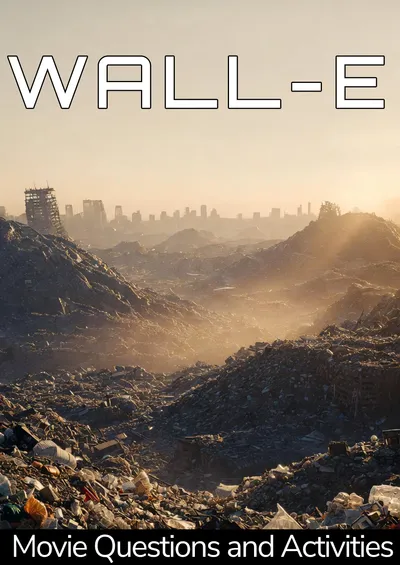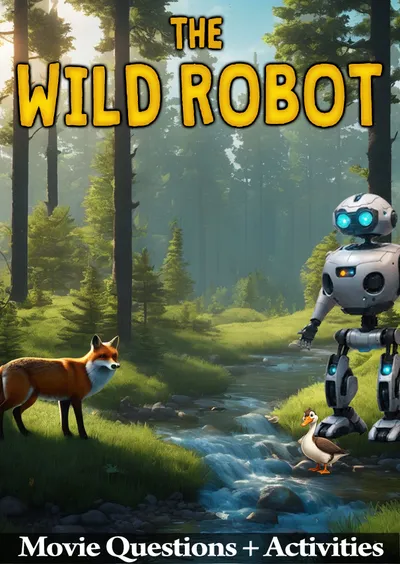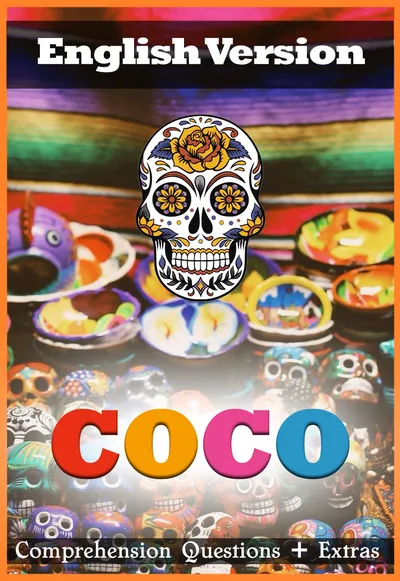
By Mr Hull's Movie Guides
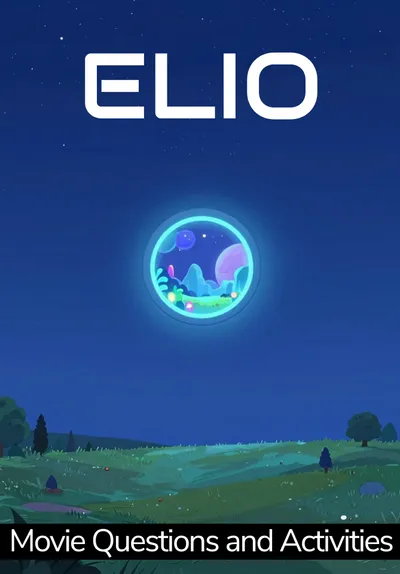
Watch the Trailer

What's Inside the Guide
This is a 17-page classroom-ready resource.
Three sets of chronological comprehension questions for differentiation. Answer keys are included for all three sets.
- 40 question set requiring full sentence answers.
- 30 question set requiring full sentence answers (10 questions removed from the 40 question set).
- 30 multiple choice question set with 3 possible answers per question. The multiple choice set also works well for ESL and ELL students.
Students create a 9 scene storyboard illustrating pivotal events from the beginning, middle, and end of the movie, with a short sentence describing the action in each scene. The comprehension questions are used to guide the sequencing.
Students work in pairs. Example answers are included.
- Mapping Elio's journey onto 8 stages across Departure, Initiation, and Return, drawing scenes and writing notes for each stage.
- 3 reflection questions.
- An archetype matching activity, followed by a class discussion.
A word search with 15 words or connected words for students to find. Students first unscramble 10 of the words, then answer 5 clues to reveal the rest. Answers are included.
Why Watch This Movie With Your Students
Here's what your students naturally take away from the movie, whether through themes, values, ideas, or perspectives.
🛸 A story about loneliness that doesn't talk down to kids. Elio's isolation isn't treated as a phase to snap out of, it's shown as something real that shapes his choices, from lying about who he is to risking a friendship to keep from being alone again. Students see that wanting to belong somewhere, even the wrong somewhere, is a believable response to grief.
🤝 Leadership gets redefined away from having all the answers. Elio starts out pretending to be Earth's ambassador because he thinks that's what leadership looks like, and the story slowly shows him that listening and connecting matter more than appearing in control. It's a useful contrast for students who assume leaders are the ones who never seem unsure.
💬 A real friendship built on honesty rather than performance. Glordon, the son of a warlord, is the one character Elio doesn't have to pretend around, and their bond grows once they start being honest with each other about what scares them. It gives students a clear example of vulnerability building trust rather than weakening it.
🕊️ Grief shown without being softened or overexplained. References to Elio's dead parents surface a couple of times in ways that feel like grief does, quiet, sudden, and unresolved rather than tied up with a lesson. It's a rare enough depiction that it can open real conversation without requiring the class to have experienced loss themselves.
📡 A concrete look at real world space surveillance and ham radio culture. Elio's obsession with contacting aliens is grounded in details about how the Air Force tracks space debris and how amateur radio operators communicate, giving the science fiction premise a factual anchor. Students get a small window into two real fields most of them will never have encountered.
🏡 A choice at the end that argues home is about people, not location. After everything Elio goes through to reach the Communiverse, he chooses to return to Earth and Olga rather than stay somewhere he once wanted more than anything. It reframes belonging as something built through relationships rather than found in a place.
Age Suitability and Content
This movie is rated PG.
⚠️ Things to be aware of:
- A boy is nearly punched during a bullying incident at camp, and another character is later struck, causing bruising and a brief bloody nose.
- An alien warlord threatens war and takes a character hostage, holding him in a cell containing a skeleton.
- Two clone characters disintegrate on screen, though not graphically.
- The movie references a main character's deceased parents, which comes up more than once and could bring up feelings of loss for some students.
- Language is limited to mild words such as 'stupid' and 'butt.'
- There is no sexual content or nudity in the movie.
📋 A free editable parent permission slip is available for this movie. It explains the educational benefits of watching movies in class and includes a space for parental consent. → Download Free Permission Slip on TpT (Free resource)
Note for educators: Movie details and age ratings in this post are sourced from IMDb, Common Sense Media, and Wikipedia to help ensure accuracy.
How My Movie Guide Helps You Teach It
Click your subject below to see how this guide supports it:
📚 English Language Arts Teachers
🗣️ ESL and ELL Teachers
🌐 Social Studies Teachers
🎬 Substitute Teachers and Cover Lessons
🏠 Homeschool Parents
💙 SEL Teachers
🌟 Supporting All Learners A movie gives students a story to follow, and the guide gives them questions to work through as they watch. For students with autism, learning difficulties, and mild to severe disabilities, that combination provides a clear focus for the lesson and a concrete way to show understanding. The format can be useful in special education and learning support classrooms, where teachers need activities that give students a defined task during viewing. Find out more about why movies work for diverse learners.
How These Guides Work: From Movie to Lesson
Watching a movie is not a break from learning. It reaches students through sight, sound, and story at once, engaging the brain in ways text alone does not, and the structured work around it is what turns the viewing into a genuine lesson. You can read the research behind this on the Why Movies Work page.
- A Teacher Notes and General Directions page opens the guide with a brief overview of everything inside: what the movie is about, then each part of the guide in order with a short description of what it entails. You know what to expect from the whole resource before you hand out a single page, so you can pick up the guide cold and teach it the same day.
- Answer keys are included for the comprehension question sets, so grading is quick and you are not rewatching the movie to check answers. Some guides also include example answers for the creative and written activities.
- Print and go: classroom ready, with no additional preparation needed. Print one the morning you need it and the lesson is ready.
- Substitute and first-timer friendly. A guide can be handed to a substitute or picked up by a teacher covering the topic for the first time. Nobody running the session needs to have seen the movie.
- Differentiated comprehension sets. Most guides include two or three question sets at different difficulty levels, and most include a multiple-choice option that works well for ESL and ELL students. One class set covers your strongest readers, your strugglers, and your language learners without separate prep.
- Activities that go beyond recall. Each guide includes structured activities that ask students to engage with the movie, not just watch it, ranging from creative and written tasks to discussion and critical thinking questions depending on the guide. That variety matters in a mixed classroom: a student who freezes on a written question set may show real understanding through a drawing or a creative task, and a confident writer gets room to go beyond recall. For the teacher, it turns a movie session into work you can grade: comprehension questions show whether students followed the plot, and the activities beyond them show whether they understood it.