Common Core Alignment
How the activities in my movie guides connect with the Common Core College and Career Readiness Anchor Standards (CCSS / CCRA).
Looking for Activities That Meet a Specific Common Core Standard?
Sometimes you know exactly what you want your students to work on, but finding an activity that fits can take time. You might be looking for ways to develop reading comprehension, encourage students to analyze characters and events, practice written communication, or get them thinking more deeply about a story.
Perhaps you have a particular Common Core Anchor Standard to address and are looking for something a little different from the usual worksheets and textbook exercises.
This is something I can help with.
I have put together this page to show how the activities in my movie guides connect with the Anchor Standards. You may be surprised by how many different skills can be explored through a single movie, depending on the activities that accompany it.
How Do Movie Guides Align With Common Core Standards?
The Anchor Standards describe the skills students should develop across Reading, Writing, Speaking and Listening, and Language. They provide a foundation for the more specific grade level standards used in schools.
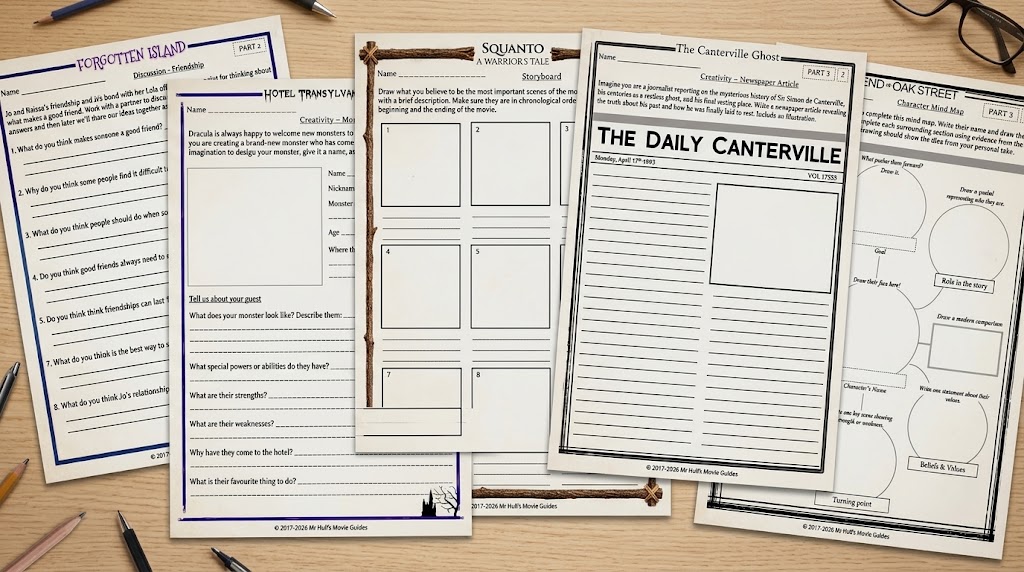
Every one of my movie guides includes comprehension questions in chronological order, giving students the opportunity to follow the story, recall important details, make connections, and develop their understanding as events unfold.
Beyond these questions, the activities vary from one guide to another. Depending on the movie, a guide may also include writing tasks, storyboards, character analysis, creative activities, discussion questions, research, and many more.
Exploring the Common Core Anchor Standards
The standards are organized into four main areas. Below, I have outlined what each area covers and how activities found across my collection of movie guides can provide opportunities to develop those skills.
Reading (CCRA.R)
Reading standards cover much more than simply understanding what happens in a story. They involve interpreting information, making inferences, recognizing important ideas, and examining how characters, events, and themes develop.
The comprehension questions, included in every guide in chronological order, encourage students to follow the development of a story, recall specific details, make inferences, and consider why characters behave in certain ways or why events unfold as they do.
Depending on the movie, additional activities such as character analysis, storyboards, and synopsis writing can provide further opportunities to examine character development, identify central ideas, recognize important events, and interpret information presented through visual media.
Read closely to determine what the text says explicitly and to make logical inferences from it; cite specific textual evidence when writing or speaking to support conclusions drawn from the text.
Determine central ideas or themes of a text and analyze their development; summarize the key supporting details and ideas.
Analyze how and why individuals, events, and ideas develop and interact over the course of a text.
Interpret words and phrases as they are used in a text, including determining technical, connotative, and figurative meanings, and analyze how specific word choices shape meaning or tone.
Analyze the structure of texts, including how specific sentences, paragraphs, and larger portions of the text (e.g., a section, chapter, scene, or stanza) relate to each other and the whole.
Assess how point of view or purpose shapes the content and style of a text.
Integrate and evaluate content presented in diverse media and formats, including visually and quantitatively, as well as in words.
Delineate and evaluate the argument and specific claims in a text, including the validity of the reasoning as well as the relevance and sufficiency of the evidence.
Analyze how two or more texts address similar themes or topics in order to build knowledge or to compare the approaches the authors take.
Read and comprehend complex literary and informational texts independently and proficiently.
Writing (CCRA.W)
Writing standards focus on communicating ideas clearly, organizing information, explaining a subject, and supporting opinions with reasoning and evidence.
The written comprehension questions in my guides give students opportunities to communicate their understanding of the story in their own words.
Many guides also include additional writing activities, although the type of task varies. These might involve summarizing a story, analyzing a character, explaining an event, developing an alternative ending, writing a persuasive response, or expressing an opinion supported by relevant examples.
Write arguments to support claims in an analysis of substantive topics or texts, using valid reasoning and relevant and sufficient evidence.
Write informative/explanatory texts to examine and convey complex ideas and information clearly and accurately through the effective selection, organization, and analysis of content.
Write narratives to develop real or imagined experiences or events using effective technique, well-chosen details, and well-structured event sequences.
Produce clear and coherent writing in which the development, organization, and style are appropriate to task, purpose, and audience.
Develop and strengthen writing as needed by planning, revising, editing, rewriting, or trying a new approach.
Use technology, including the Internet, to produce and publish writing and to interact and collaborate with others.
Conduct short as well as more sustained research projects based on focused questions, demonstrating understanding of the subject under investigation.
Gather relevant information from multiple print and digital sources, assess the credibility and accuracy of each source, and integrate the information while avoiding plagiarism.
Draw evidence from literary or informational texts to support analysis, reflection, and research.
Write routinely over extended time frames (time for research, reflection, and revision) and shorter time frames (a single sitting or a day or two) for a range of tasks, purposes, and audiences.
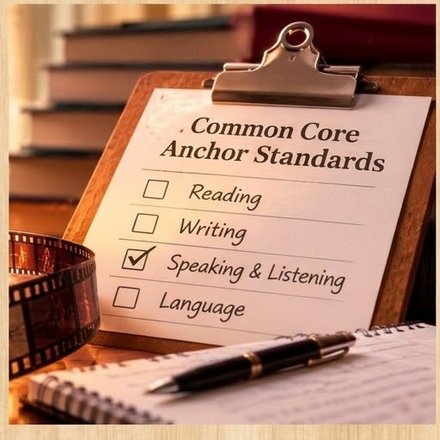
Speaking and Listening (CCRA.SL)
These standards involve participating in discussions, listening to different perspectives, communicating ideas, and building on the contributions of others.
Watching a movie is itself a Speaking and Listening skill. Long before any worksheet, students are taking in a story told through pictures, sound, music, and dialogue all at once, and making sense of it as it happens. That is exactly the kind of skill the standards below are built around.
Some of my guides also include discussion and reflection questions that can be used to encourage classroom conversation, invite different interpretations, and give students the opportunity to explain their thinking.
The shared experience of watching a movie also gives students something concrete to refer to when discussing characters, events, decisions, and ideas.
Prepare for and participate effectively in a range of conversations and collaborations with diverse partners, building on others' ideas and expressing their own clearly and persuasively.
Integrate and evaluate information presented in diverse media and formats, including visually, quantitatively, and orally.
Evaluate a speaker's point of view, reasoning, and use of evidence and rhetoric.
Present information, findings, and supporting evidence such that listeners can follow the line of reasoning and the organization, development, and style are appropriate to task, purpose, and audience.
Make strategic use of digital media and visual displays of data to express information and enhance understanding of presentations.
Adapt speech to a variety of contexts and communicative tasks, demonstrating command of formal English when indicated or appropriate.
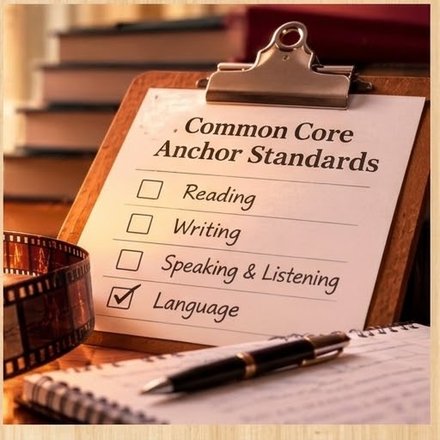
Language (CCRA.L)
Language standards focus on the conventions of written and spoken English, including grammar, punctuation, capitalization, and spelling.
The written responses and activities throughout my guides provide opportunities for students to practice these skills while developing their ability to communicate clearly and accurately.
Demonstrate command of the conventions of standard English grammar and usage when writing or speaking.
Demonstrate command of the conventions of standard English capitalization, punctuation, and spelling when writing.
Apply knowledge of language to understand how language functions in different contexts, to make effective choices for meaning or style, and to comprehend more fully when reading or listening.
Determine or clarify the meaning of unknown and multiple-meaning words and phrases by using context clues, analyzing meaningful word parts, and consulting general and specialized reference materials, as appropriate.
Demonstrate understanding of figurative language, word relationships, and nuances in word meanings.
Acquire and use accurately a range of general academic and domain-specific words and phrases sufficient for reading, writing, speaking, and listening at the college and career readiness level; demonstrate independence in gathering vocabulary knowledge when encountering an unknown term important to comprehension or expression.
Find a Movie Guide to Match Your Teaching Objectives
Perhaps you are looking for an activity that addresses a particular Reading Anchor Standard, need a writing task that supports a specific learning objective, or simply want to introduce a different approach to developing students' comprehension and critical thinking skills.
You may also be a homeschool parent looking for meaningful activities to accompany a movie, or a teacher who needs to demonstrate how a planned classroom activity connects with the curriculum.
Whatever brings you here, I hope you find something useful.
Each movie guide has its own combination of activities, so the standards it addresses will vary.
I hope this makes it a little easier to find something that fits what you're looking for. Whether you're planning a particular lesson, working towards a curriculum requirement, or simply looking for a different way to approach a learning objective, there may be a movie guide here that does exactly what you need.
Looking for a specific movie or grade level? Check the blog — I give every guide its own post.
The Common Core State Standards are © 2010 National Governors Association Center for Best Practices and Council of Chief State School Officers. All rights reserved. The standards are quoted from the official Common Core website at thecorestandards.org, where you can read them in full.