By Mr Hull's Movie Guides
Watch the Trailer

What's Inside the Guide
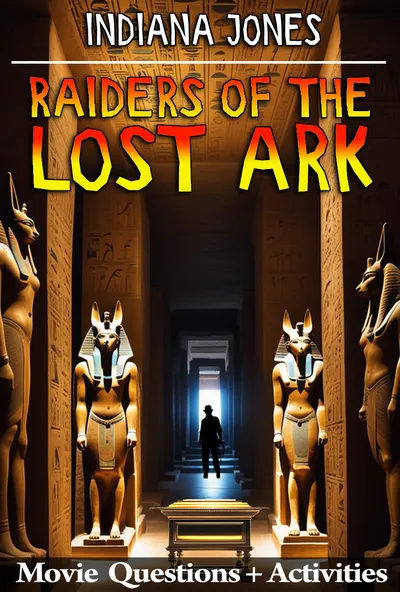
This is a 15-page classroom-ready resource.
Three sets of differentiated comprehension questions in chronological order. Answer keys are included for all three sets.
- 50 question set requiring full sentence answers.
- 35 question set (15 removed from the full set).
- 35 multiple choice question set with three possible answers each. The multiple choice set works well with ESL and ELL students.
Students have the option to reference the comprehension questions to help sequence events.
- A nine scene storyboard of what they believe are the most important parts of the movie, including a brief description for each scene.
- A synopsis of the movie, written using their storyboards as a guide.
Students imagine they are reporters for the college newspaper who have heard rumors of Dr. Jones's adventure, and write interview notes from the perspective of both Professor Jones and Marion Ravenwood to gather both sides of the story. Using those notes, students then write a news article that includes a drawing and quotes drawn from their interviews.
“I had originally planned a script writing unit at the end of the school year but due to the timing of senior finals I had to shorten the unit so we analyzed Raiders of the Lost Ark and Temple of Doom. This resource helped me do that.”
— Shawn N.
“A great movie guide is essential in having students stay engaged in the movie. This one was great!”
— Mitchell G.
Why Watch This Movie With Your Students
Here's what your students naturally take away from the movie, whether through themes, values, ideas, or perspectives.
🏺 Puts archaeology on screen as a real academic pursuit. Indiana Jones is introduced as a university professor of archaeology before he becomes an adventurer, and the movie treats the recovery and study of historical artifacts as work with real stakes. It gives students a way into archaeology that goes beyond a textbook definition.
🗺️ Sets its story against a specific moment in history. The movie invents its central chase, but builds it on Nazi Germany's real historical fascination with the occult in the years before World War II. Students see how a real historical detail can be the seed for an entire fictional plot, and get a window into a lesser known corner of Nazi history.
❓ Raises the question of who owns the past. The movie repeatedly puts Jones in conflict with people who want to sell, weaponize, or bury historical artifacts rather than study them. It gives students a concrete case for discussing where objects like the Ark should end up, and who has the right to decide.
🧭 Follows a hero who succeeds through persistence rather than luck. Jones survives booby traps, betrayals, and armed opponents mostly by refusing to quit, not by having an easy path. Students see perseverance modeled directly, scene by scene, rather than described to them.
🤝 Builds its story around a partnership. Marion Ravenwood is not a passive character. She fights back, makes her own decisions, and stays central to the danger and stakes of the story throughout, giving students a female character with real agency inside a story that could easily have sidelined her.
Age Suitability and Content
This movie is rated PG.
⚠️ Things to be aware of:
- The movie includes frequent hand to hand combat and gunfire, including one point blank shooting.
- A climactic scene shows a man's face and body dissolving under supernatural power, and another shows a man killed by a plane propeller with visible blood.
- There is one use of a stronger profanity along with milder language such as hell, damn, and bastard.
- A scene shows two characters drinking heavily during a contest, and other scenes include social drinking and smoking.
- There is brief innuendo and one scene implying that two characters spent the night together, without any explicit content shown.
📋 A free editable parent permission slip is available for this movie. It explains the educational benefits of watching movies in class and includes a space for parental consent. → Download Free Permission Slip on TpT (Free resource)
Note for educators: Movie details and age ratings in this post are sourced from IMDb, Common Sense Media, and Wikipedia to help ensure accuracy.
How My Movie Guide Helps You Teach It
Click your subject below to see how this guide supports it:
📚 English Language Arts Teachers
🗣️ ESL and ELL Teachers
🎬 Substitute Teachers and Cover Lessons
🏠 Homeschool Parents
📜 History Teachers
🌟 Supporting All Learners A movie gives students a story to follow, and the guide gives them questions to work through as they watch. For students with autism, learning difficulties, and mild to severe disabilities, that combination provides a clear focus for the lesson and a concrete way to show understanding. The format can be useful in special education and learning support classrooms, where teachers need activities that give students a defined task during viewing. Find out more about why movies work for diverse learners.
How These Guides Work: From Movie to Lesson
Watching a movie is not a break from learning. It reaches students through sight, sound, and story at once, engaging the brain in ways text alone does not, and the structured work around it is what turns the viewing into a genuine lesson. You can read the research behind this on the Why Movies Work page.
- A Teacher Notes and General Directions page opens the guide with a brief overview of everything inside: what the movie is about, then each part of the guide in order with a short description of what it entails. You know what to expect from the whole resource before you hand out a single page, so you can pick up the guide cold and teach it the same day.
- Answer keys are included for the comprehension question sets, so grading is quick and you are not rewatching the movie to check answers. Some guides also include example answers for the creative and written activities.
- Print and go: classroom ready, with no additional preparation needed. Print one the morning you need it and the lesson is ready.
- Substitute and first-timer friendly. A guide can be handed to a substitute or picked up by a teacher covering the topic for the first time. Nobody running the session needs to have seen the movie.
- Differentiated comprehension sets. Most guides include two or three question sets at different difficulty levels, and most include a multiple-choice option that works well for ESL and ELL students. One class set covers your strongest readers, your strugglers, and your language learners without separate prep.
- Activities that go beyond recall. Each guide includes structured activities that ask students to engage with the movie, not just watch it, ranging from creative and written tasks to discussion and critical thinking questions depending on the guide. That variety matters in a mixed classroom: a student who freezes on a written question set may show real understanding through a drawing or a creative task, and a confident writer gets room to go beyond recall. For the teacher, it turns a movie session into work you can grade: comprehension questions show whether students followed the plot, and the activities beyond them show whether they understood it.