By Mr Hull's Movie Guides
Watch the Trailer

What's Inside the Guide
This is a 8-page classroom-ready resource.
Two differentiated sets of comprehension questions in chronological order. Answer keys are included for both sets.
- 20 question set requiring full sentence answers.
- 20 multiple choice question set with three answer options each, which also works well for ESL and ELL students.
This part covers several activities.
- Writing about their favorite character from the movie, describing their personality and what they liked or disliked about them, then drawing that character.
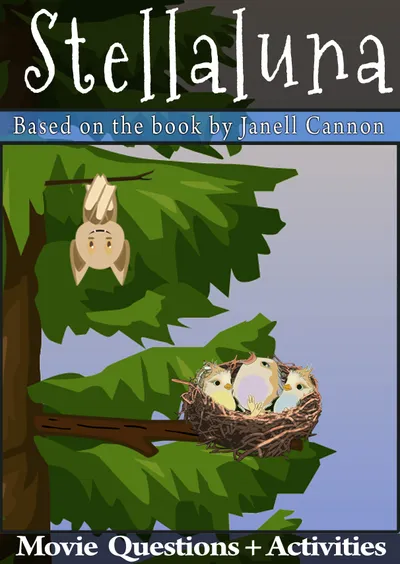
- Writing a sentence for each letter in the word STELLALUNA.
- Writing about moments in the movie where they felt sad, happy, and excited.
Why Watch This Movie With Your Students
Here's what your students naturally take away from the movie, whether through themes, values, ideas, or perspectives.
🦇 Introduces a story about identity built entirely from an animal's natural instincts. Stellaluna's struggle is not really about being different in the abstract, it is about a bat being asked to live like a bird. Students can see clearly why what feels natural to one creature can feel wrong to another.
🪺 Shows what it means to be raised by a family that is not your own. Mother bird takes Stellaluna in and cares for her, but she also expects her to give up the behaviors that come naturally to her. Students get a grounded look at the tension between belonging and being asked to change.
🦉 Builds tension through a genuine threat in the form of the owl. The bats and birds are pursued more than once, giving the story real stakes rather than a purely gentle, low conflict plot. Students stay engaged through moments of danger before the story resolves.
👯 Explores friendship across difference through Pip, Flitter, and Flap. The birds are initially unkind to Stellaluna because she cannot do what they do, but they come to accept and rely on her anyway. Students see a friendship that survives real friction rather than one that is easy from the start.
🌙 Gives students a clear moment of self-discovery when Stellaluna meets other bats. She learns why she has always felt out of place and finally understands her own instincts as a bat rather than a flaw. Students witness a turning point where confusion becomes clarity.
🤝 Ends with reconciliation rather than separation. Stellaluna does not have to choose between her bat family and her bird friends. Students see that accepting someone's differences does not mean the relationship has to end, it can be the reason it becomes stronger.
Age Suitability and Content
This movie is rated G.
⚠️ Things to be aware of:
- A predatory owl chases the bats and birds on more than one occasion.
- The baby birds initially mock Stellaluna for looking different, calling her names before eventually accepting her.
- No sexual content, strong language, or substance use of any kind.
Note for educators: Movie details and age ratings in this post are sourced from IMDb, Common Sense Media, and Wikipedia to help ensure accuracy.
How My Movie Guide Helps You Teach It
Click your subject below to see how this guide supports it:
📚 English Language Arts Teachers
🗣️ ESL and ELL Teachers
🎬 Substitute Teachers and Cover Lessons
🏠 Homeschool Parents
💙 SEL Teachers
🌟 Supporting All Learners A movie gives students a story to follow, and the guide gives them questions to work through as they watch. For students with autism, learning difficulties, and mild to severe disabilities, that combination provides a clear focus for the lesson and a concrete way to show understanding. The format can be useful in special education and learning support classrooms, where teachers need activities that give students a defined task during viewing. Find out more about why movies work for diverse learners.
How These Guides Work: From Movie to Lesson
Watching a movie is not a break from learning. It reaches students through sight, sound, and story at once, engaging the brain in ways text alone does not, and the structured work around it is what turns the viewing into a genuine lesson. You can read the research behind this on the Why Movies Work page.
- A Teacher Notes and General Directions page opens the guide with a brief overview of everything inside: what the movie is about, then each part of the guide in order with a short description of what it entails. You know what to expect from the whole resource before you hand out a single page, so you can pick up the guide cold and teach it the same day.
- Answer keys are included for the comprehension question sets, so grading is quick and you are not rewatching the movie to check answers. Some guides also include example answers for the creative and written activities.
- Print and go: classroom ready, with no additional preparation needed. Print one the morning you need it and the lesson is ready.
- Substitute and first-timer friendly. A guide can be handed to a substitute or picked up by a teacher covering the topic for the first time. Nobody running the session needs to have seen the movie.
- Differentiated comprehension sets. Most guides include two or three question sets at different difficulty levels, and most include a multiple-choice option that works well for ESL and ELL students. One class set covers your strongest readers, your strugglers, and your language learners without separate prep.
- Activities that go beyond recall. Each guide includes structured activities that ask students to engage with the movie, not just watch it, ranging from creative and written tasks to discussion and critical thinking questions depending on the guide. That variety matters in a mixed classroom: a student who freezes on a written question set may show real understanding through a drawing or a creative task, and a confident writer gets room to go beyond recall. For the teacher, it turns a movie session into work you can grade: comprehension questions show whether students followed the plot, and the activities beyond them show whether they understood it.