By Mr Hull's Movie Guides
Watch the Trailer

What's Inside the Guide
This is a 7-page classroom-ready resource.
35 questions requiring full sentence answers. An answer key is included.
This part covers two activities.
- Five higher level thinking questions for students to answer after watching, designed for the class to come together and discuss and explain their answers further, with example teacher answers included as a springboard for additional discussion.
- A nine scene storyboard of what they consider the most important parts of the movie, with a brief description for each scene, used as a guide to write a synopsis essay of the movie.
“Great for a teacher teaching this unit for the first time!”
— Emily H.
Why Watch This Movie With Your Students
Here's what your students naturally take away from the movie, whether through themes, values, ideas, or perspectives.
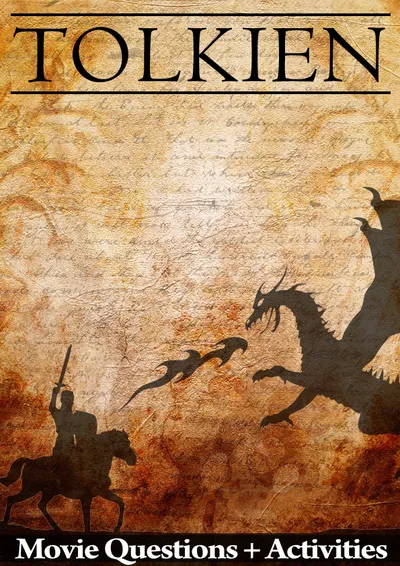
📖 Traces how real experience becomes fiction. The movie follows Tolkien's friendships, loss, and academic interests without ever showing him write The Lord of the Rings itself, instead building toward the moment he begins The Hobbit. Students get a grounded look at where a famous fictional world came from.
🤝 Centers a tight friendship among fellow outcasts. Tolkien and three other boys form a close bond at school built on shared ambition and inside jokes, a friendship the movie treats as genuinely formative. Their connection carries through university and into the war, giving students a real example of sustained friendship over years.
⚔️ Puts World War One losses at the emotional center of the story. Tolkien and his friends are pulled into the trenches, and two of his closest friends are killed in the fighting. The movie ties those losses directly to the emotional weight behind his later writing rather than treating the war as background detail.
🗣️ Follows a genuine passion for language and philology. Tolkien's academic path is shaped by his fascination with language study under a mentor at Oxford, a detail the movie treats as central to who he becomes. It gives students a specific, real example of a niche academic interest developing into something much larger.
💛 Includes a fully realized romantic relationship. Tolkien's relationship with Edith develops over years, including a period where she is briefly engaged to someone else before the two reunite. The movie gives her more depth and her own goals rather than treating her as a simple love interest.
🎓 Offers a real world case study in turning personal history into art. By the end, students see Tolkien as a married professor at Oxford, drawing on everything that came before to begin writing. It is a concrete example of how lived experience, not just imagination alone, can shape creative work.
Age Suitability and Content
This movie is rated PG-13.
⚠️ Things to be aware of:
- The movie includes intense World War One combat scenes with gunfire, explosions, and a flamethrower, and two of Tolkien's close friends are killed.
- The main character becomes visibly drunk in one scene after being emotionally hurt.
- There is infrequent mild language and a couple of romantic kissing scenes.
- Brief nude paintings are shown in the background of one scene, with no other nudity or sexual content in the movie.
📋 A free editable parent permission slip is available for this movie. It explains the educational benefits of watching movies in class and includes a space for parental consent. → Download Free Permission Slip on TpT (Free resource)
Note for educators: Movie details and age ratings in this post are sourced from IMDb, Common Sense Media, and Wikipedia to help ensure accuracy.
How My Movie Guide Helps You Teach It
Click your subject below to see how this guide supports it:
📚 English Language Arts Teachers
🎬 Substitute Teachers and Cover Lessons
🏠 Homeschool Parents
📜 History Teachers
🌟 Supporting All Learners A movie gives students a story to follow, and the guide gives them questions to work through as they watch. For students with autism, learning difficulties, and mild to severe disabilities, that combination provides a clear focus for the lesson and a concrete way to show understanding. The format can be useful in special education and learning support classrooms, where teachers need activities that give students a defined task during viewing. Find out more about why movies work for diverse learners.
How These Guides Work: From Movie to Lesson
Watching a movie is not a break from learning. It reaches students through sight, sound, and story at once, engaging the brain in ways text alone does not, and the structured work around it is what turns the viewing into a genuine lesson. You can read the research behind this on the Why Movies Work page.
- A Teacher Notes and General Directions page opens the guide with a brief overview of everything inside: what the movie is about, then each part of the guide in order with a short description of what it entails. You know what to expect from the whole resource before you hand out a single page, so you can pick up the guide cold and teach it the same day.
- Answer keys are included for the comprehension question sets, so grading is quick and you are not rewatching the movie to check answers. Some guides also include example answers for the creative and written activities.
- Print and go: classroom ready, with no additional preparation needed. Print one the morning you need it and the lesson is ready.
- Substitute and first-timer friendly. A guide can be handed to a substitute or picked up by a teacher covering the topic for the first time. Nobody running the session needs to have seen the movie.
- Differentiated comprehension sets. Most guides include two or three question sets at different difficulty levels, and most include a multiple-choice option that works well for ESL and ELL students. One class set covers your strongest readers, your strugglers, and your language learners without separate prep.
- Activities that go beyond recall. Each guide includes structured activities that ask students to engage with the movie, not just watch it, ranging from creative and written tasks to discussion and critical thinking questions depending on the guide. That variety matters in a mixed classroom: a student who freezes on a written question set may show real understanding through a drawing or a creative task, and a confident writer gets room to go beyond recall. For the teacher, it turns a movie session into work you can grade: comprehension questions show whether students followed the plot, and the activities beyond them show whether they understood it.