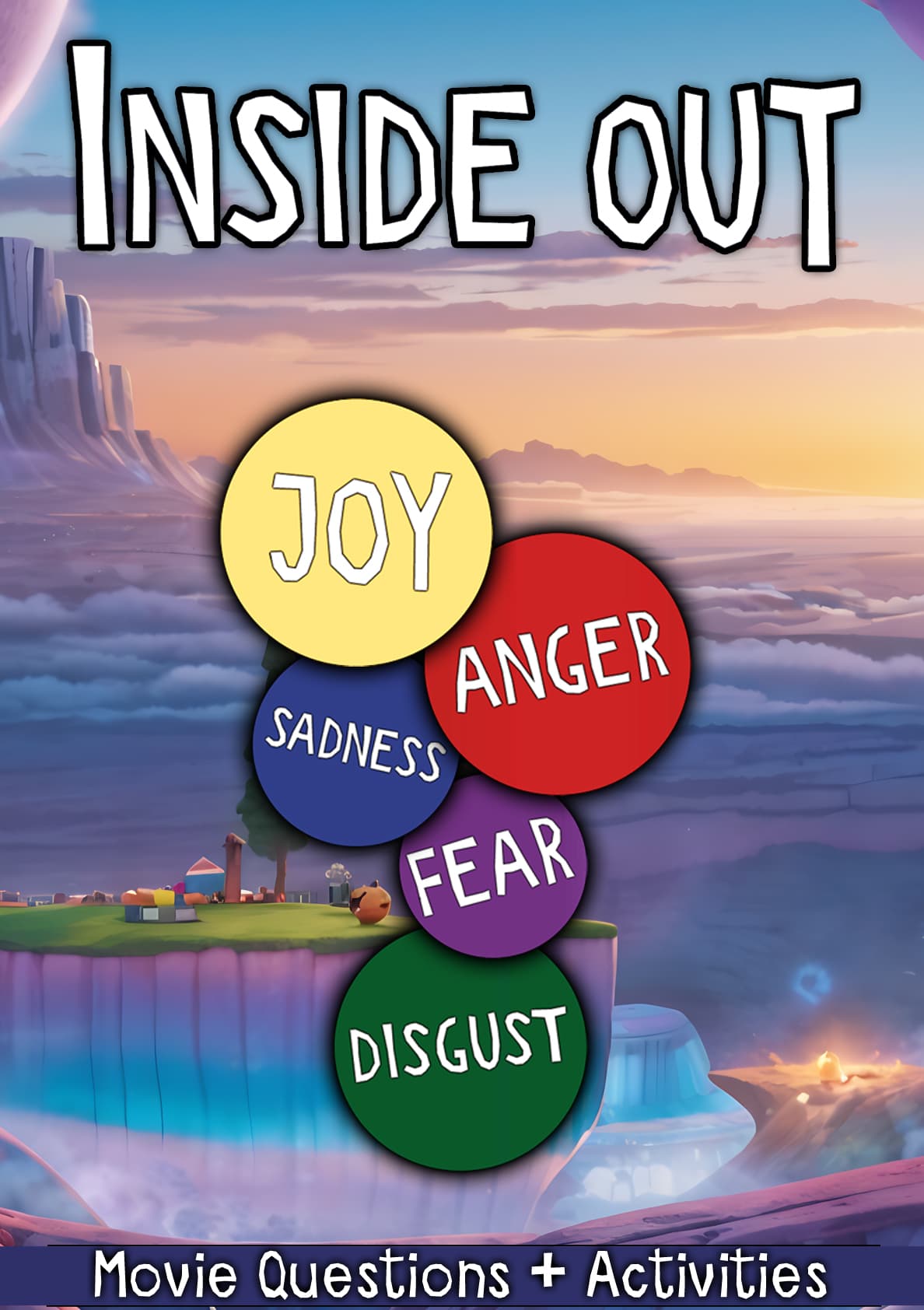
By Mr Hull's Movie Guides

Watch the Trailer

Why Watch This Movie With Your Students
Here's what your students naturally take away from the movie, whether through themes, values, ideas, or perspectives.
😰 Anxiety gets a face and a personality. Anxiety arrives as a fast talking, well meaning character who slowly takes over. Students see how a feeling meant to help can end up causing the exact problems it was trying to prevent.
🧠 Emotional vocabulary expands beyond the basics. Alongside the five original emotions, Envy, Embarrassment, and Ennui give students new and specific words for feelings they already experience but may not have named before.
🏒 A familiar setting raises the stakes. A weekend hockey camp built around making the team gives the story a relatable source of pressure, tying big internal changes to a situation many students recognize from their own lives.
🪞 Self-image takes center stage. Riley's sense of who she is gets tested as she compares herself to others and tries to fit in, reflecting a common experience for students moving through early adolescence.
🤝 Friendship under pressure. Riley's relationships with her two best friends shift as new social dynamics appear, giving students a way to think about how friendships change during this stage of growing up.
😅 Humor keeps heavier themes approachable. The movie balances its more serious emotional content with visual gags and character comedy, keeping the tone light enough for a classroom setting.
Age Suitability and Content
This movie is rated PG.
⚠️ Things to be aware of:
- Some scenes depicting anxiety attacks and panic may be intense for sensitive viewers.
- Mild language includes words such as 'shut up' and 'idiot'.
- No sexual content or substance use.
📋 A free editable parent permission slip is available for this movie. It explains the educational benefits of watching movies in class and includes a space for parental consent. → Download Free Permission Slip on TpT (Free resource)
Note for educators: Movie details and age ratings in this post are sourced from IMDb, Common Sense Media, and Wikipedia to help ensure accuracy.
How My Movie Guide Helps You Teach It
📚 English Language Arts Teachers. Inside Out 2 works well for ELA classes covering character development, narrative structure, and descriptive writing. The guide includes comprehension questions in three differentiated sets, alongside a storyboard and synopsis task and a character writing activity focused on one of the new emotions, giving students a range of reading, sequencing, and writing work.
🗣️ ESL and ELL Teachers. The multiple choice comprehension set is written with ESL and ELL students in mind, offering a more accessible entry point alongside the full sentence question sets. The visual storytelling and clear emotional cues in the movie also support language learners following along.
🎬 Substitute Teachers and Cover Lessons. With clear, self-contained sections covering comprehension, storyboarding, and character writing, this guide works well as a sub plan. Students can move through the comprehension questions independently while the movie plays, with minimal setup required.
🏠 Homeschool Parents. The mix of comprehension questions, creative writing, and emotion-focused character work makes this guide adaptable for homeschool settings, with three differentiated question sets allowing it to be adjusted to a student's level.
💙 SEL Teachers. Inside Out 2 is a strong fit for SEL, with its central focus on naming and understanding emotions such as anxiety, envy, and embarrassment. The guide's character worksheets ask students to connect new emotions to familiar ones and consider how each can lead to a positive outcome, giving SEL teachers a direct way to use the movie's themes.
🌟 Supporting All Learners Movie guides can be a wonderfully calm fit for students with autism, learning difficulties, and mild to severe disabilities. The structured format gives every student a clear purpose during viewing, easing uncertainty and allowing them to engage at their own pace. If you teach in a special education or learning support setting, you may find this guide a gentle and practical resource. Find out more about why movies work for diverse learners.
What's Inside the Guide
This is a 20-page classroom-ready resource.
Part 1: Comprehension Questions
Three differentiated sets of chronological comprehension questions: 50 full sentence questions, a shortened 30 question version, and a 30 question multiple choice set suited to ESL and ELL students. Answer keys included for all three sets.
Part 2: Storyboard and Synopsis
Students draw a nine scene storyboard of what they consider the most important moments in the movie, then use it to write a synopsis.
Part 3: Character Worksheets
Group or pair work where students take one of the five original emotions and explore how it connects to the new emotions introduced in the movie.
Part 4: Discussion Questions
Pair work covering five discussion questions to be shared and discussed as a class.
“This was an easy resource to use while we watched Inside Out 2 for SEL means. It was also more interactive for a movie worksheet”
— Brie H
“Such a great resource to accompany the movie! My students liked the departure from the traditional worksheets given with movies.”
— Grammar and Grace (TPT Seller)
How These Guides Work: From Movie to Lesson
Watching a movie is not a break from learning. It reaches students through sight, sound, and story at once, engaging the brain in ways text alone does not, and the structured work around it is what turns the viewing into a genuine lesson. You can read the research behind this on the Why Movies Work page.
- A Teacher Notes and General Directions page opens the guide with a brief overview of everything inside: what the movie is about, then each part of the guide in order with a short description of what it entails. You know what to expect from the whole resource before you hand out a single page, so you can pick up the guide cold and teach it the same day.
- Answer keys are included for the comprehension question sets, so grading is quick and you are not rewatching the movie to check answers. Some guides also include example answers for the creative and written activities.
- Print and go: classroom ready, with no additional preparation needed. Print one the morning you need it and the lesson is ready.
- Substitute and first-timer friendly. A guide can be handed to a substitute or picked up by a teacher covering the topic for the first time. Nobody running the session needs to have seen the movie.
- Differentiated comprehension sets. Most guides include two or three question sets at different difficulty levels, and most include a multiple-choice option that works well for ESL and ELL students. One class set covers your strongest readers, your strugglers, and your language learners without separate prep.
- Activities that go beyond recall. Each guide includes structured activities that ask students to engage with the movie, not just watch it, ranging from creative and written tasks to discussion and critical thinking questions depending on the guide. That variety matters in a mixed classroom: a student who freezes on a written question set may show real understanding through a drawing or a creative task, and a confident writer gets room to go beyond recall. For the teacher, it turns a movie session into work you can grade: comprehension questions show whether students followed the plot, and the activities beyond them show whether they understood it.