By Mr Hull's Movie Guides
Watch the Trailer

What's Inside the Guide
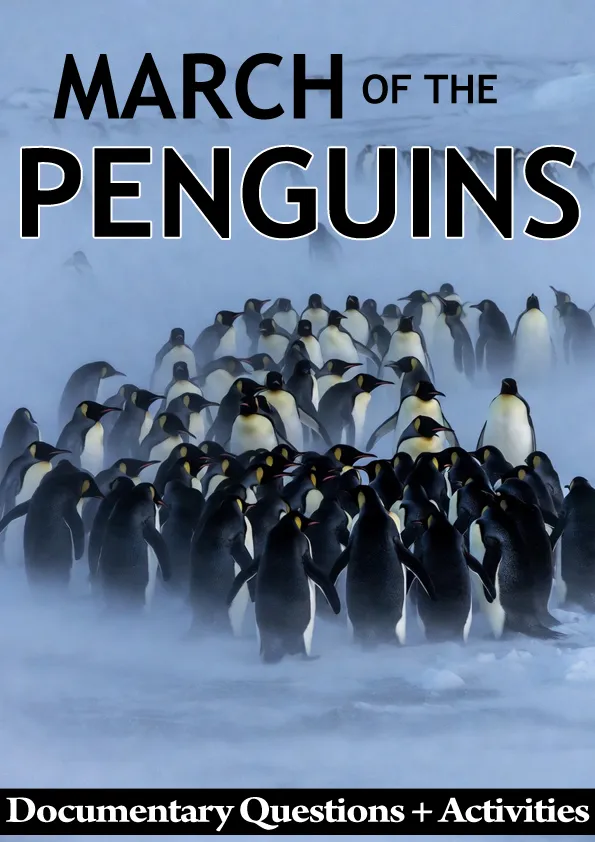
This is a 12-page classroom-ready resource.
Two differentiated sets in chronological order. Answer keys are included for both sets.
- 25 question set requiring full sentence answers.
- 25 multiple choice question set with three answer options each. The multiple choice set works well for ESL and ELL students.
Students work in pairs to answer four critical thinking questions related to the documentary, including a question on climate change. Example answers are included.
Students use the comprehension questions to guide sequencing.
- A nine scene storyboard illustrating pivotal events from the documentary, with a short description for each scene explaining the main idea it represents.
- A synopsis of the documentary, written using their storyboards as a guide.
Using a provided Emperor Penguin Fact Sheet, students complete drawing, vocabulary, description, and creative writing tasks that reinforce key adaptations, behaviors, and vocabulary from the documentary.
Why Watch This Documentary With Your Students
Here's what your students naturally take away from the documentary, whether through themes, values, ideas, or perspectives.
🐧 A real, unscripted survival story with higher stakes than fiction. Nothing in this documentary is staged. The penguins' seventy mile trek, months without food, and constant threat from predators and storms all happened during filming, giving students a genuine account of what survival costs in one of the harshest environments on the planet.
🥚 Parenting shown as a physically demanding, shared responsibility. After the female lays her egg, she transfers it to the male, who then protects it alone through the Antarctic winter while she treks back to the sea to feed. Students see an unusually literal example of shared labor between two parents working toward the same outcome at different times.
❄️ An unfiltered look at survival, including loss. Some penguins do not survive the trek or the winter, and the documentary does not shy away from showing this. It gives students a grounded, honest picture of nature rather than a softened one, useful for discussing how survival and risk work in the wild.
🌍 A full breeding cycle captured across more than a year of filming. The documentary tracks the same colony from their autumn departure from the sea through to the following spring, when the ice finally melts enough for the growing chicks to survive alone. Students can follow one continuous process from beginning to end rather than a condensed or reenacted version of events.
🎙️ Narration that shapes how the footage is understood. Morgan Freeman's narration frames the visuals with commentary about the penguins' behavior and struggle, giving students something concrete to examine about how narration itself shapes the meaning of a documentary. It offers an accessible entry point into thinking critically about how nonfiction filmmaking presents its subject.
🏆 A widely recognized example of the documentary genre at its best. March of the Penguins won the Academy Award for Best Documentary Feature, giving students a benchmark example of what the genre can achieve. It offers a clear model of how a nonfiction film builds a complete narrative arc entirely from real footage.
Age Suitability and Content
This documentary is rated G.
⚠️ Things to be aware of:
- Some penguins do not survive the journey or the winter, shown factually without graphic detail.
- A sea lion is shown attacking and carrying off a penguin.
- A penguin egg is shown cracking and failing to survive the cold.
- There is a brief, non-graphic reference to penguin mating.
- There is no strong language, drinking, drugs, or smoking in the documentary.
Note for educators: Documentary details and age ratings in this post are sourced from IMDb, Common Sense Media, and Wikipedia to help ensure accuracy.
How My Guide Helps You Teach It
Click your subject below to see how this guide supports it:
📚 English Language Arts Teachers
🗣️ ESL and ELL Teachers
🔬 Science Teachers
🎬 Substitute Teachers and Cover Lessons
🏠 Homeschool Parents
🌍 Geography Teachers
🔭 STEM Teachers
🌟 Supporting All Learners A movie gives students a story to follow, and the guide gives them questions to work through as they watch. For students with autism, learning difficulties, and mild to severe disabilities, that combination provides a clear focus for the lesson and a concrete way to show understanding. The format can be useful in special education and learning support classrooms, where teachers need activities that give students a defined task during viewing. Find out more about why movies work for diverse learners.
How These Guides Work: From Documentary to Lesson
Watching a documentary is not a break from learning. It reaches students through sight, sound, and story at once, engaging the brain in ways text alone does not, and the structured work around it is what turns the viewing into a genuine lesson. You can read the research behind this on the Why Movies Work page.
- A Teacher Notes and General Directions page opens the guide with a brief overview of everything inside: what the documentary is about, then each part of the guide in order with a short description of what it entails. You know what to expect from the whole resource before you hand out a single page, so you can pick up the guide cold and teach it the same day.
- Answer keys are included for the comprehension question sets, so grading is quick and you are not rewatching the documentary to check answers. Some guides also include example answers for the creative and written activities.
- Print and go: classroom ready, with no additional preparation needed. Print one the morning you need it and the lesson is ready.
- Substitute and first-timer friendly. A guide can be handed to a substitute or picked up by a teacher covering the topic for the first time. Nobody running the session needs to have seen the documentary.
- Differentiated comprehension sets. Most guides include two or three question sets at different difficulty levels, and most include a multiple-choice option that works well for ESL and ELL students. One class set covers your strongest readers, your strugglers, and your language learners without separate prep.
- Activities that go beyond recall. Each guide includes structured activities that ask students to engage with the documentary, not just watch it, ranging from creative and written tasks to discussion and critical thinking questions depending on the guide. That variety matters in a mixed classroom: a student who freezes on a written question set may show real understanding through a drawing or a creative task, and a confident writer gets room to go beyond recall. For the teacher, it turns a documentary session into work you can grade: comprehension questions show whether students followed the plot, and the activities beyond them show whether they understood it.