By Mr Hull's Movie Guides

Watch the Trailer
What's Inside the Guide
This is a 14-page classroom-ready resource.
Comprehension questions in chronological order, with two sets per story for differentiation. Answer keys are included.
- 15 questions requiring full sentence answers.
- 15 multiple choice questions with 3 possible answers.
- 15 questions requiring full sentence answers.
- 15 multiple choice questions with 3 possible answers.
A storyboard for each of the stories. Students draw a 6-scene storyboard of what they believe to be the most important parts in the story, with a brief description for each scene, and can look at the questions to help with the sequences.
Two creative tasks, one for each story.
- Toad's Next Mania (The Wind in the Willows). Students draw and label one of Professor Brain's inventions, then write about Toad's adventure.
- Party Invitation (The Legend of Sleepy Hollow). Students act as Mr. Van Tassel's assistant, plan their invitation in the draft section, then design the final invitation.
There are 20 words from both stories to find in the big word search.
Why Watch This Movie With Your Students
Here's what your students naturally take away from the movie, whether through themes, values, ideas, or perspectives.
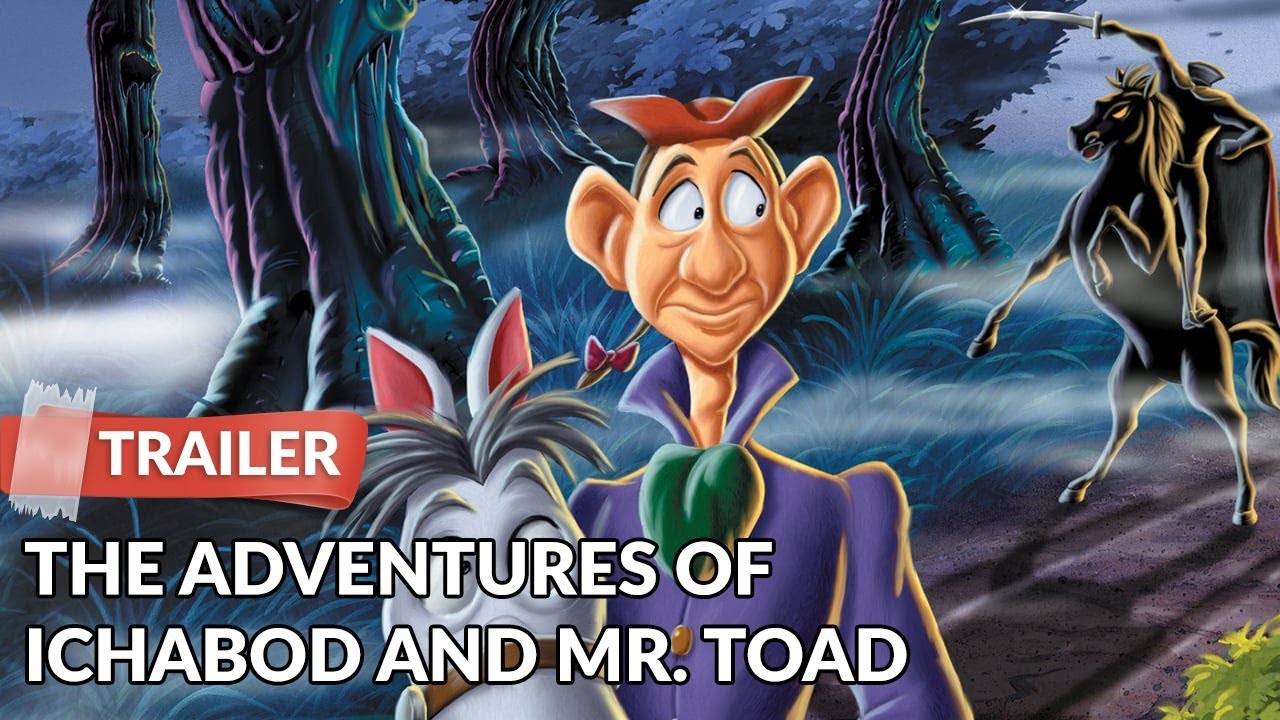
📚 Two classic books on screen. The first story is based on Kenneth Grahame's novel The Wind in the Willows and the second on Washington Irving's short story The Legend of Sleepy Hollow. A class meets both stories in a single viewing. Each story has its own narrator and its own characters, so the two books stay distinct on screen.
🐸 A reckless friend and the friends who stay loyal. J. Thaddeus Toad moves from one craze to the next, and his love of motorcars ends with him trading Toad Hall to a gang of weasels for a stolen car. Rat, Mole, and MacBadger confront him, try to get his case reopened after his conviction, and then help him take back the deed to the estate. Once he is cleared, Toad takes up flying.
🎃 A legend that feeds a man's fear. Brom Bones learns that Ichabod Crane is superstitious and tells him the legend of the Headless Horseman at a Halloween frolic. On the ride home, Ichabod jumps at every sound, even laughing at a noise that turns out to be cattails knocking on a log, before the real Horseman appears. The Horseman chases him toward a covered bridge, where Brom's own story said he would vanish.
🔍 An ending left open. The Sleepy Hollow story ends with Ichabod's hat and a shattered pumpkin found by the bridge and no sign of the schoolmaster. Rumors say he survived and married a wealthy widow in a distant county, while the Dutch settlers remain certain the Headless Horseman carried him off. Brom marries Katrina, and the narrator closes the story by exclaiming that he is getting out of there.
😠 A rivalry between a bully and a schoolmaster. Brom Bones targets new schoolmaster Ichabod Crane because of his odd appearance and competes with him for Katrina Van Tassel. Ichabod wins Katrina over at every opportunity, though he also has one eye on her family's fortune. At the Halloween frolic, Brom tries without success to keep the two apart.
🎤 Two narrators and a library frame. Both stories are introduced through live-action scenes in a library, where each narrator mentions literary characters from English and American literature before settling on Toad or Ichabod. Basil Rathbone narrates the Toad story and Bing Crosby narrates the Sleepy Hollow story, and each story has its own songs.
Age Suitability and Content
This movie is rated G.
⚠️ Things to be aware of:
- Mild cartoon violence includes characters wielding guns, knives, axes, and swords, with no visible injuries.
- The Headless Horseman chases Ichabod through a dark wood and swings a sword at him.
- Characters drink beer and smoke cigars and pipes, and cartoon weasels are shown passed out drunk.
- No sexual content.
- No profanity.
Note for educators: Movie details and age ratings in this post are sourced from IMDb, Common Sense Media, and Wikipedia to help ensure accuracy.
How My Movie Guide Helps You Teach It
Click your subject below to see how this guide supports it:
📚 English Language Arts Teachers
🗣️ ESL and ELL Teachers
🎬 Substitute Teachers and Cover Lessons
🏠 Homeschool Parents
💙 SEL Teachers
🌟 Supporting All Learners A movie gives students a story to follow, and the guide gives them questions to work through as they watch. For students with autism, learning difficulties, and mild to severe disabilities, that combination provides a clear focus for the lesson and a concrete way to show understanding. The format can be useful in special education and learning support classrooms, where teachers need activities that give students a defined task during viewing. Find out more about why movies work for diverse learners.
How These Guides Work: From Movie to Lesson
Watching a movie is not a break from learning. It reaches students through sight, sound, and story at once, engaging the brain in ways text alone does not, and the structured work around it is what turns the viewing into a genuine lesson. You can read the research behind this on the Why Movies Work page.
- A Teacher Notes and General Directions page opens the guide with a brief overview of everything inside: what the movie is about, then each part of the guide in order with a short description of what it entails. You know what to expect from the whole resource before you hand out a single page, so you can pick up the guide cold and teach it the same day.
- Answer keys are included for the comprehension question sets, so grading is quick and you are not rewatching the movie to check answers. Some guides also include example answers for the creative and written activities.
- Print and go: classroom ready, with no additional preparation needed. Print one the morning you need it and the lesson is ready.
- Substitute and first-timer friendly. A guide can be handed to a substitute or picked up by a teacher covering the topic for the first time. Nobody running the session needs to have seen the movie.
- Differentiated comprehension sets. Most guides include two or three question sets at different difficulty levels, and most include a multiple-choice option that works well for ESL and ELL students. One class set covers your strongest readers, your strugglers, and your language learners without separate prep.
- Activities that go beyond recall. Each guide includes structured activities that ask students to engage with the movie, not just watch it, ranging from creative and written tasks to discussion and critical thinking questions depending on the guide. That variety matters in a mixed classroom: a student who freezes on a written question set may show real understanding through a drawing or a creative task, and a confident writer gets room to go beyond recall. For the teacher, it turns a movie session into work you can grade: comprehension questions show whether students followed the plot, and the activities beyond them show whether they understood it.