By Mr Hull's Movie Guides
Watch the Trailer

What's Inside the Guide
This is a 16-page classroom-ready resource.
All of the comprehension questions are made while I watch the movie, with the additional activities created to connect directly with its themes and story.
- Completed before watching the movie. Students first note what they already picture when explorers arrive somewhere unfamiliar, then compare two accounts of strangers arriving in an already inhabited land and consider why the accounts differ. The task also explores how people can experience and tell the story of the same event in different ways, and it works well for class discussion afterwards too.
Common Core Anchor Standards: R.6 · R.9
Assess how point of view or purpose shapes the content and style of a text.
Students read two short accounts of the same ship arriving at an island, one from the traveler and one from the islander, and explain how each person's choice of words shapes the way the arrival is seen and how both can be telling the truth.
Analyze how two or more texts address similar themes or topics in order to build knowledge or to compare the approaches the authors take.
Students compare the traveler's account with the islander's account of the same event, noting what is the same in both and where they differ.
Comprehension questions in chronological order, made in two sets for differentiation. Answer keys are included for both sets.
- 48 questions requiring full sentence answers.
- 48 multiple choice questions with 3 possible answers each, which may also work well with ESL and ELL students.
Common Core Anchor Standards: R.1 · SL.2
Read closely to determine what the text says explicitly and to make logical inferences from it; cite specific textual evidence when writing or speaking to support conclusions drawn from the text.
Students answer 48 chronological questions in full sentences, or 48 multiple choice questions, on details the movie shows outright, such as what year it is, what Smith threw on the fire and how the princess got her new name.
Integrate and evaluate information presented in diverse media and formats, including visually, quantitatively, and orally.
The questions can only be answered from what students saw and heard in the movie, such as why Smith is stripped of his position and whipped.
Students use the movie questions to guide sequencing.
- A 9-scene storyboard illustrating pivotal events from the movie, with a short description of the main idea each scene represents.
- A synopsis of the movie, written using the storyboard as a guide.
Common Core Anchor Standards: R.2 · W.4
Determine central ideas or themes of a text and analyze their development; summarize the key supporting details and ideas.
Students draw a 9 scene storyboard of the pivotal events in the movie, each with a short description of the main idea it represents, so they must decide which events matter most and sum each one up.
Produce clear and coherent writing in which the development, organization, and style are appropriate to task, purpose, and audience.
Using the storyboard as a guide, students write a synopsis of the movie, so the writing must be clear and organized, with the events in order.
- Six critical thinking questions compare the movie's dramatized portrayal with real historical events, covering why filmmakers make creative choices and how the story might look from other perspectives. Good for class discussion afterwards too.
Common Core Anchor Standards: R.6 · R.9
Assess how point of view or purpose shapes the content and style of a text.
Students consider how the movie might differ if told from the Indigenous perspective and why it never reveals her Indigenous name, so they judge how point of view shapes what the story shows.
Analyze how two or more texts address similar themes or topics in order to build knowledge or to compare the approaches the authors take.
Students compare the movie's romance between the young woman and John Smith with historical evidence and consider why filmmakers rearrange real events, so they weigh the movie's version of events against what is known from history.
Common Core Anchor Standards throughout the guide: L.1 · L.2
Demonstrate command of the conventions of standard English grammar and usage when writing or speaking.
Students are expected to follow standard English grammar and usage in everything they write in this guide.
Demonstrate command of the conventions of standard English capitalization, punctuation, and spelling when writing.
Students are expected to use correct capitalization, punctuation and spelling in everything they write in this guide.
Why Watch This Movie With Your Students
Here's what your students naturally take away from the movie, whether through themes, values, ideas, or perspectives.
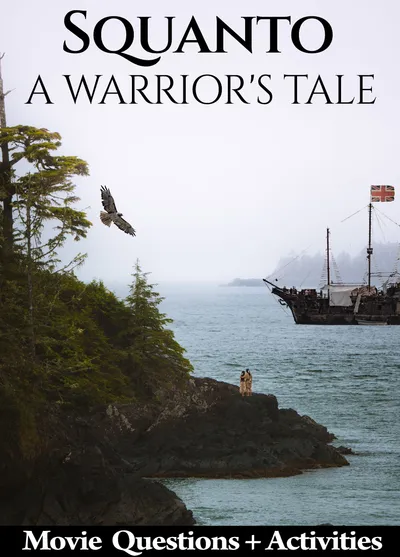
🌎 Two cultures meet. The movie follows early contact between English settlers and the Powhatan people in Virginia, with trade, language and misunderstanding all in play. Seeing the encounter from both sides gives a class a concrete case of cultural contact to discuss.
🏛️ Real people and a real settlement. The story is set at Jamestown and is inspired by historical figures including John Smith, Pocahontas and John Rolfe. That gives students real names and a real place to research once the movie ends.
🏷️ A central character without a name. The movie never speaks her name, neither Pocahontas nor her Indigenous name, and it addresses this directly on screen. When a woman at Jamestown begins to ask her name, the question is cut off with the answer that it is not her name anymore and that she has no name, and the woman replies that they will have to give her one. The only name she is given is Rebecca, after her baptism, so the movie shows a name being set aside and replaced by the English, which gives students a concrete detail to discuss about names and identity.
⚓ Smith faces a hard choice. John Smith is pardoned after being sentenced to death, is later pressured into governing the colony, and ends up torn between Pocahontas and an offer to lead his own expedition. Tracking his choices gives students a character to follow on questions of responsibility, love and ambition.
🏕️ Life at Jamestown. The movie shows the settlers dealing with disease, shortages and a harsh winter after they arrive. It gives students a picture of how much the colony depended on supplies from England and on food from the people already living there.
🌲 Story told through images and voice-over. The movie uses voice-over narration and images of woods, fields and rivers, not only dialogue, to tell its story. It also closes on images of nature, which gives students something to interpret as well as watch.
Age Suitability and Content
This movie is rated PG-13.
⚠️ Things to be aware of:
- Some battle violence, including shootings, spearings and beatings.
- Brief gore, including a severed head and a severed hand.
- Mild profanity, including the word 'bastard'.
- Brief partial nudity and some kissing.
- Some smoking and drinking by the settlers.
📋 A free editable parent permission slip is available for this movie. It explains the educational benefits of watching movies in class and includes a space for parental consent. → Download Free Permission Slip on TpT (Free resource)
Note for educators: Movie details and age ratings in this post are sourced from IMDb, Common Sense Media, and Wikipedia to help ensure accuracy.
How My Movie Guide Helps You Teach It
Click your subject below to see how this guide supports it:
📚 English Language Arts Teachers
🗣️ ESL and ELL Teachers
🎬 Substitute Teachers and Cover Lessons
🏠 Homeschool Parents
📜 History Teachers
🌟 Supporting All Learners A movie gives students a story to follow, and the guide gives them questions to work through as they watch. For students with autism, learning difficulties, and mild to severe disabilities, that combination provides a clear focus for the lesson and a concrete way to show understanding. The format can be useful in special education and learning support classrooms, where teachers need activities that give students a defined task during viewing. Find out more about why movies work for diverse learners.
How These Guides Work: From Movie to Lesson
Watching a movie is not a break from learning. It reaches students through sight, sound, and story at once, engaging the brain in ways text alone does not, and the structured work around it is what turns the viewing into a genuine lesson. You can read the research behind this on the Why Movies Work page.
- A Teacher Notes and General Directions page opens the guide with a brief overview of everything inside: what the movie is about, then each part of the guide in order with a short description of what it entails. You know what to expect from the whole resource before you hand out a single page, so you can pick up the guide cold and teach it the same day.
- Answer keys are included for the comprehension question sets, so grading is quick and you are not rewatching the movie to check answers. Some guides also include example answers for the creative and written activities.
- Print and go: classroom ready, with no additional preparation needed. Print one the morning you need it and the lesson is ready.
- Substitute and first-timer friendly. A guide can be handed to a substitute or picked up by a teacher covering the topic for the first time. Nobody running the session needs to have seen the movie.
- Differentiated comprehension sets. Most guides include two or three question sets at different difficulty levels, and most include a multiple-choice option that works well for ESL and ELL students. One class set covers your strongest readers, your strugglers, and your language learners without separate prep.
- Activities that go beyond recall. Each guide includes structured activities that ask students to engage with the movie, not just watch it, ranging from creative and written tasks to discussion and critical thinking questions depending on the guide. That variety matters in a mixed classroom: a student who freezes on a written question set may show real understanding through a drawing or a creative task, and a confident writer gets room to go beyond recall. For the teacher, it turns a movie session into work you can grade: comprehension questions show whether students followed the plot, and the activities beyond them show whether they understood it.